
Media Release
- Keeping Namibia Connected - The Customer Contact Centre
- Why is my internet slow? Understanding what affects your connection
- Telecom Namibia Board extends appointment of acting CEO
- Telecom Namibia Clarification on Executive Leadership Announcement
- Acting CEO Appointment
- Telecom Namibia, Angola Telecom, and SATCAB Sign Landmark SARSSy and Equiano Submarine Cable Systems Master Service Agreement in Angola
- Telecom Namibia Signs Pilot Commercial Agreement with Angola’s GGPEN for Angosat-2 Satellite Services
Telegram - Newsletter
- Telegram – May 2026
- Telegram – December 2025 (Festive Season Edition)
- Telegram – October 2025
- Telegram - May 2025
- Telegram - December 2024 (Festive Season Edition)
- Telegram - September 2024
- Telegram - June 2024
- Telegram - March 2024
- Telegram - December 2023
- Telegram - November 2023
- Telegram - March 2023
- Telegram - Jan-Feb 2021
- Telegram - October 2021
- Telegram - December 2021
- Telegram - April-May 2020
- Telegram - September 2020
- Telegram - December 2020
28 February 2013
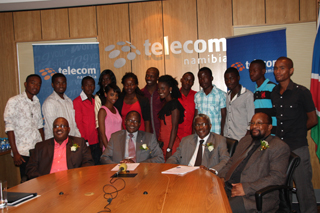 In line with its corporate social investment, Telecom Namibia granted 14 bursaries valued at N$1.3 million to disadvantaged and financially needy students from all 13 regions to pursue their studies at institutions of higher learning in the country. Last year a total of 20 bursaries were awarded under the Telecom Namibia Bursary Scheme. The scheme has 82 students who are pursuing their higher education goals and meet national labour needs. The handover ceremony was held in Windhoek on Monday, 28 January 2013, and was officiated by the Deputy Minister of Education Dr David Namwandi. Also present at the occasion were the Telecom Namibia Managing Director Frans Ndoroma and the company’s Senior Manager for Training and Development Dr Raimo Naanda.
The focus of the Telecom Namibia Bursary Scheme is to contribute to building Namibia’s human resources capacity mainly in the fields of accounting, electroninic engineering, telecommunications engineering and information technology to address both company-specific and national skills requirements.
The bursary recipients for the 2013 academic year are:
1. Loundy /Goagoseb, from Karas Region, for Bachelor of Accounting at the Polytechnic of Namibia
2. Jennifer Smith, from Hardap Region, for Bachelor of Accounting at the University of Namibia
3. Gerson Kanduuombe, from Erongo Region, Bachelor of Electronic Engineering, at the Polytechnic of Namibia
4. Tuuliki Autoni, from Omusati Region, for Bachelor of Electronic Engineering at the Polytechnic of Namibia
5. Herman Shikusho, from Kavango Region, for Bachelor of Electronic Engineering at the Polytechnic of Namibia
6. Limbere Steven, from Kavango Region, for Bachelor of Electronic Engineering at the University of Namibia
7. Romario Uirab, from Erongo Region, for Bachelor of Electronic Engineering at the Polytechnic of Namibia
8. Johannes Amakali, from Oshikoto Region, for Bachelor of Electronic Engineering at the Polytechnic of Namibia
9. Visken Sililo, from Caprivi Region, for Bachelor of Electronic Engineering at the University of Namibia
10. Kautoora Mukuambi, from Khomas Region, for Bachelor of Electrical Engineering at the Polytechnic of Namibia
11. Linea Kayavala, from Ohangwena Region, for Bachelor of Electronic Engineering at the University of Namibia
12. Kaliketu Hashipara, from Otjozondjupa Region, for Bachelor of Electronic Engineering at the University of Namibia
13. Hawakeshe Kamwangha, from Oshana Region, for Bachelor of Telecommunication Engineering at the Polytechnic of Namibia
14. Ailonga Aupindi, also from Oshana Region, for Bachelor of Electronic Engineering at the Polytechnic of Namibia Telecom Namibia Managing Director Frans Ndoroma said the bursaries granted are but a small contribution to the national effort of deveolpoing the skills of young Namibians.
“We are giving these young people this opportunity because of an awareness that the achievement of our strategic objective of a sustainable, world-class company and the creation of a better life for all as encapsulated in Vision 2030 depends, in the long term, on the level of investment in quality education and training we are making today,”
Ndoroma said. Deputy Minister of Education Dr David Namwandi said that the handover of bursaries was a response to the clarion call to makeg education a shared responsibitly of all stakeholders.
“Each bursary awarded by coprorate Namibia strengthens our offensive on provery, unemployment and social exculsion, by providing learners from disadvantaged communities with an opputuinty to access quality education,” the deputy minister said. Dr Namwandi said Government has made great investments in education since independence 23 years ago, but that more still has to be done in ensuring that Namibians have the skills required by the economy.
“We are therefore proud of Telecom Namibia whose acts of corporate giving are geared towards making a difference in our society year-after-year, especially by creating opportunities for young Namibians to acquire skills needed to grow the economy and extricate our people from poverty,” he said.
29 November 2012
Deal gives Telecom Namibia a key foothold in the GSM operator business
Telecom Namibia on Wednesday closed the acquisition of Powercom (Pty) Ltd t/a Leo, Namibia’s second mobile operator.
The Sale of Shares Agreement was entered into between Telecom Namibia and Guinea Fowl Investments Two (Pty) Ltd, Powercom (Pty) Ltd, Investec Bank Ltd and Nedbank Ltd on 2 March 2012, followed by the Sale of Shares reinstatement and amending agreement said by the above parties on 13 November 2012. The transaction which sought to transfer control of Powercom t/a Leo to Telecom Namibia was duly approved by the Communication Regulatory Authority of Namibia (CRAN) on 11 October 2012. The transaction was already approved by the Namibia Competition Commission (NaCC) on 27 April this year. At a special ceremony held in Windhoek on 28 November 2012, Telecom Namibia paid the purchase consideration of N$2.00 to Guinea Fowl Investments Two (Pty) Ltd in respect of the acquisition of 100% equity interests in Powercom (Pty) Ltd. The acquisition gave Telecom Namibia a key foothold in the GSM operator market and created an important opportunity for the company to pursue its fixed-mobile convergence strategy. The purchase consideration of N$2.00, which is the amount which is paid by Telecom Namibia to the sellers of Powercom (Pty) Ltd, is the repayment of debt in Leo amounting to N$180 million. Of this amount, N$60 million was transferred upon signature of the Sale of Shares Agreement, while an amount of N$120 million is repayable over a three year period.
Importance of the Acquisition
Welcoming the deal on Wednesday, Information and Communication Technology Minister Joel Kaapanda said:” As shareholder, the Government is happy that the deal that was approved by Cabinet is finally concluded. The way we value this acquisition is not based on just the net tangible assets. We value this deal based on what we think eventually it will be worth.”Hon. Kaapanda said that the local mobile industry was still developing and that there was huge growth potential. Telecom’s Board Chairman Joseph Iita said the acquisition was “an exciting step forward” in support of the strategic intent of our company to go GSM.
The Minister further said that the acquisition of GSM network assets will be beneficial to strengthening the overall operation efficiency of Telecom Namibia's mobile service, providing a better customer service, sustainable growth, competitiveness and innovation into the future.” “We envision Leo’s takeover as a rosy garden of straightforward synergies thanks to a set of complementary network technologies, spectrum positions and operations,” Iita said. He said Leo was a critical resource for Telecom Namibia in the company’s quest to remain competitive and deliver shareholder value, adding that it was good for competition and innovation, especially in the mobile arena.
28 November 2012
Telecom Namibia today announced that the Communication Regulatory Authority of Namibia (CRAN) has formally cleared the Company’s completed acquisition of Powercom (Pty) Ltd, trade name Leo, the country’s second mobile operator. The transaction was already approved by the Namibia Competition Commission (NaCC) on 27 April this year.
CRAN’s approval marks the final approval required for Telecom Namibia’s overall transaction with Guinea Fowl Investments Two (Pty) Ltd to acquire 100% equity stake in Powercom (Pty) Ltd T/A Leo, effectively placing the Company under the full control of Telecom Namibia.
Commenting on the development, Frans Ndoroma, MD of Telecom Namibia, said; “This is a milestone achievement for Telecom Namibia and it undoubtedly positions TN as a fully-fledged ICT service provider. We are indeed pleased to welcome Powercom (Pty) Ltd t/a Leo customers and staff to the Telecom Namibia family.”
Ndoroma said that Telecom Namibia’s acquisition of Powercom (Pty) Ltd T/A Leo will see mobile users across the country benefiting from increased investment in even better mobile services and new technology in the future. “Our immediate focus from today will be on improving services, products, marketing, and network coverage to meet the needs of the Namibian market,” he said.
“With Powercom (Pty) Ltd T/A Leo as part of the Telecom Namibia Group, it will serve as an active platform to introduce innovative fixed-mobile convergence (FMC) services and using the all-powerful Telecom Namibia infrastructure for backhauling and transport capability,” the MD added.
“I thank our shareholder for the confidence they placed in us, as well as our Minister of ICT, Hon. Joel Kaapnda for his unwavering support to us. I would like to extend my gratitude to the Board of Directors of Telecom Namibia, the management team as well as our employees and Union Executive who supported TN during the bidding for this acquisition. Last but not least, I thank Mr. Stanley Similo, in his capacity as Acting CEO, who managed to steer the company forward with all employees onboard, during these turbulent times
Telecom Namibia’s Chief Strategy Officer Theo Klein will assume the role of Interim Chief Executive Officer at Leo with immediate effect. He will report to the Board of Directors of the Company.
"I am very pleased to join Powercom (Pty) Ltd T/A Leo at this decisive moment in its development. The opportunities at the newly acquired entity are both exciting and challenging. Together with the Company's solid management team and employees, we are looking forward to further establishing a strong platform and infrastructure that will enable us to deliver new products that compliment Telecom Namibia's existing services," said Klein.
The acquisition of Powercom (Pty) Ltd T/A Leo represents a unique opportunity to gain full management control of a mobile business with growth potential. Telecom Namibia is committed to accelerating the growth of Powercom (Pty) Ltd T/A Leo and increasing its share in the dynamic Namibian mobile market. This represents a great opportunity that will allow us to fully integrate the new acquisition to the Telecom Namibia family and take advantage of Group synergies and jointly becoming a stronger player in the market.
In addition, this transaction delivers significant customer, shareholder and public benefits that are available at this level only from the combination of these two companies with complementary network technologies and operations. Telecom Namibia is confident in its ability to execute a seamless integration, and with additional spectrum and network capabilities, the Company can better face competition, build for the future and help meet customers’ demands for FMC services.


